

How Remote Patient Monitoring Works — A Guide for Patients in McAllen, TX

A blood pressure reading taken in a clinic once every six months is a single photograph. Thirty readings taken at home over a month is a film, and the two tell very different stories.
That gap is the whole point of remote patient monitoring. Blood pressure in the exam room runs high for many people simply because they are in an exam room. Blood sugar swings on a schedule no quarterly visit will ever capture. Weight gain from fluid retention in heart failure shows up days before the shortness of breath does.
Remote patient monitoring, usually shortened to RPM, is a Medicare-covered service that closes that gap using a device you keep at home. Here is exactly how it works.
What Remote Patient Monitoring Is
RPM uses an FDA-cleared medical device that measures something physiological, blood pressure, blood glucose, weight, or oxygen saturation, and transmits that reading automatically to your medical practice, where clinical staff review it and act on it.
Three things it is not:
It is not a smartwatch. Consumer fitness trackers are not medical-grade, and their readings are not used for clinical decisions in this program.
It is not an app you have to fill in. The device transmits on its own. You take the reading; the technology handles the rest.
It is not a substitute for your doctor. RPM feeds better data into the same physician relationship. Someone still has to interpret those numbers and change your treatment, and that is your doctor's job.
The Devices
The device is matched to the condition being monitored. Most patients use exactly one.
| Device | What It Measures | Typically Used For |
|---|---|---|
| Connected blood pressure cuff | Systolic and diastolic pressure, pulse | High blood pressure, heart disease, kidney disease |
| Connected glucometer | Blood sugar | Type 2 diabetes, especially after a medication change |
| Connected scale | Weight, day-to-day changes | Heart failure (fluid retention), medical weight management |
| Pulse oximeter | Blood oxygen saturation, pulse | COPD, chronic lung conditions, recovery after pneumonia |
| Spirometer | Lung airflow | Asthma and COPD management |
Most devices used in RPM programs connect over built-in cellular service, so no home internet, no Wi-Fi password, and no smartphone is required.
How It Works, Step by Step
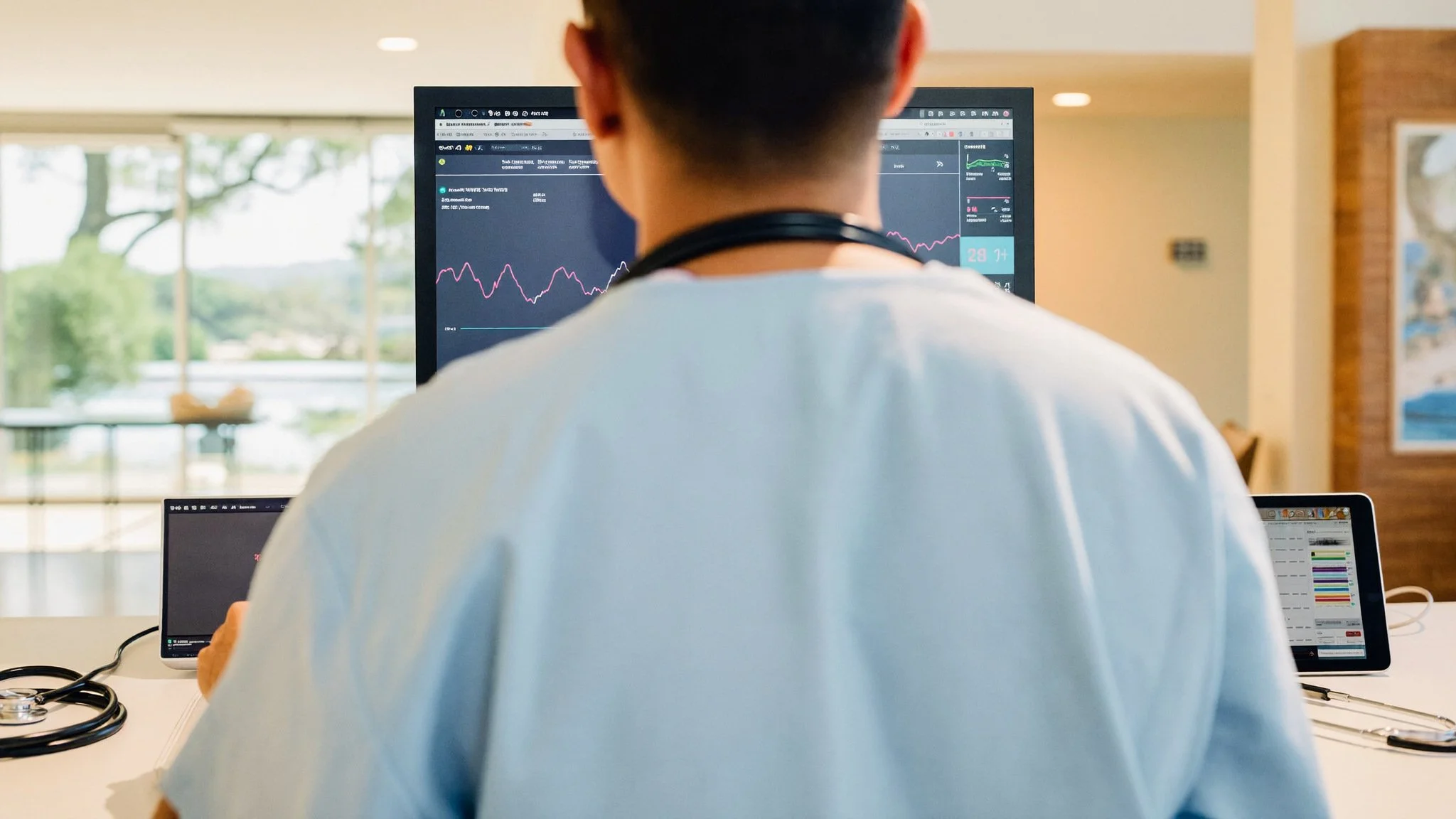
Step 1: Your physician determines you are a candidate. RPM starts with a clinical decision. Your doctor identifies a condition where day-to-day numbers would change how you are treated, then explains the program and obtains your consent, including what it may cost you. Consent is documented, and you can withdraw it at any time.
Step 2: You receive and set up the device. The device is provided to you and configured before you take it home. Setup is walked through in person, how to position the cuff, when to take the reading, what the lights and beeps mean. In most cases it arrives ready to use out of the box.
Step 3: You take a reading, and it sends itself. Usually once a day, at roughly the same time. You do not log in, enter numbers, or press send. The reading transmits automatically to your care team.
Step 4: Your care team reviews the data. Clinical staff monitor incoming readings against the range your physician set for you. Readings outside that range are flagged for review, and out-of-range results prompt a call, sometimes the same day.
Step 5: You have a monthly check-in. At least once a month, someone from your care team talks with you live to review the trend, ask about symptoms and side effects, and relay your physician's adjustments to medication or dosing. This live conversation is a required part of the service, not an optional extra, and it pairs naturally with telehealth consultations when an appointment is needed.
Step 6: The data follows you into your next visit. When you come in, your physician is not asking what your blood pressure has been. They are looking at 30 readings and deciding what to do about them, alongside your diagnostic testing and lab results.
Which Conditions Benefit Most
High blood pressure. The clearest case. Home readings are more predictive of cardiovascular risk than office readings, and monitored patients reach their targets faster because dose changes stop waiting for the next appointment.
Type 2 diabetes. Especially valuable in the weeks after starting or adjusting insulin or another medication, when trends matter more than any single number.
Heart failure. Daily weight is one of the earliest signals of fluid retention. A rise of two to three pounds in a couple of days can prompt an intervention that prevents a hospitalization.
COPD and chronic lung disease. Falling oxygen saturation gives warning of a flare-up before it becomes an emergency.
Medical weight management. Objective, consistent weight data between visits supports treatment decisions in a medically supervised weight management program and gives you a real trend instead of a single number on a clinic scale.
After a hospital discharge. The 30 days after discharge carry the highest risk of readmission. Monitoring during that window catches deterioration early.
Does Medicare Cover Remote Patient Monitoring?
Yes. RPM is covered under Medicare Part B, and coverage got broader in 2026.
Previously, Medicare would only pay for device monitoring if readings were collected on at least 16 days out of every 30, and only for management time reaching 20 minutes in a month. Patients who needed shorter, more targeted monitoring, a few weeks after a medication change for instance, fell outside the rules. Effective January 1, 2026, Medicare added codes covering shorter monitoring periods and shorter management time, so more people now qualify.
Here is what the pieces look like on a statement, in plain language:
| Code | What It Covers |
|---|---|
| 99453 | One-time setup and education on how to use the device |
| 99445 (new in 2026) | Device supply and data transmission for 2 to 15 days in a 30-day period |
| 99454 | Device supply and data transmission for 16 or more days in a 30-day period |
| 99470 (new in 2026) | First 10 minutes of monthly management time, including one live conversation with you |
| 99457 | First 20 minutes of monthly management time, including one live conversation with you |
| 99458 | Each additional 20 minutes of management time in the same month |
Your practice bills either the shorter or the longer version of each pair in a given month, never both. As with most Part B services, you are responsible for 20 percent coinsurance after your deductible, commonly covered in full by a Medigap plan, Medicaid, or QMB status. Medicare Advantage plans cover RPM but set their own cost-sharing, so confirm with your plan before enrolling.
Privacy and Your Data
Your readings are protected health information under HIPAA, exactly like the rest of your medical record, and they travel encrypted to your care team.
What the device sends is the measurement and its timestamp. A blood pressure cuff transmits a blood pressure. It has no camera, no microphone, and no location tracking, and it is not listening in your home. Your data goes to your medical practice for your care, not to advertisers, not to employers.
Who Is a Good Candidate, and Who Is Not
RPM tends to help most when there is a number worth watching and a decision that number would change: uncontrolled hypertension, diabetes in a period of adjustment, heart failure, COPD, or the weeks following a hospital stay.
It is a poor fit when a condition is stable and well controlled with no expected medication changes, when a patient cannot physically use the device and no caregiver is available to help, or when the numbers would not alter the treatment plan. A responsible practice will tell you when monitoring would not add anything. If your blood pressure has been at goal for three years on the same medication, daily readings are unlikely to change your care.
Remote Patient Monitoring and Chronic Care Management Together
RPM and Chronic Care Management are separate Medicare programs, and many patients are enrolled in both. They answer different questions.
RPM supplies the data: what your numbers are actually doing at home, day by day. Chronic Care Management supplies the coordination: the care plan, the medication review across every prescriber you see, the follow-up after a hospital stay, the monthly contact covering all of your conditions rather than one measurement.
For someone with diabetes, high blood pressure, and early kidney disease, the combination is close to ideal, daily numbers plus a monthly conversation that ties everything together. Medicare permits billing both in the same month, provided the time spent on each is tracked separately.
Remote Patient Monitoring at Giraldo Internal Medicine in McAllen, TX
Giraldo Internal Medicine offers remote patient monitoring for eligible patients across McAllen and the Rio Grande Valley. Devices are set up and explained in person, readings are reviewed by our clinical team, and your monthly check-in happens in English or Spanish, whichever you prefer.
If you are managing high blood pressure, diabetes, heart failure, or COPD, or you have just come home from the hospital, ask us whether remote monitoring would help. We are currently accepting new patients.
Giraldo Internal Medicine
1200 Savannah Ave STE 14, McAllen, TX 78503
Phone: (956) 000-0000
Website: giraldointernalmedicine.com
Call us today or visit our website to request an appointment.
Frequently Asked Questions
Q: Do I need internet service or a smartphone for remote patient monitoring?
A: Usually not. Most devices used for RPM include built-in cellular connectivity and transmit on their own, with no Wi-Fi, no app, and no smartphone required. If you can turn the device on and take a reading, you can use it.
Q: How often do I have to take a reading?
A: Typically once a day, though your physician sets the schedule based on your condition. Under the rules that took effect in 2026, Medicare covers monitoring periods as short as 2 to 15 days in a month, so shorter, targeted stretches, such as after a medication change, are now covered.
Q: What happens if I forget to take a reading?
A: Nothing dramatic. Missing a day now and then is normal, and your care team will notice a pattern of missed readings and follow up to see whether something is in the way. Consistency matters because trends are what make the data useful, but no one is penalized for a missed morning.
Q: Is someone watching my numbers 24 hours a day?
A: No, and it is important to be clear about this. Readings are reviewed by clinical staff during business hours, and out-of-range results are flagged and followed up. RPM is not an emergency monitoring service. If you have chest pain, severe shortness of breath, signs of a stroke, or any other emergency, call 911, do not wait for a call about your readings.
Q: How much does remote patient monitoring cost me?
A: Under Original Medicare, the standard Part B rules apply: 20 percent coinsurance after your deductible. A Medigap plan, Medicaid, or QMB status typically covers that amount in full. Medicare Advantage plans set their own cost-sharing, so call the number on your card to confirm what you would owe.
Q: Do I have to pay for the device?
A: No. In an RPM program the device is supplied to you as part of the service, and Medicare's payment to the practice covers the device supply and data transmission. You are not buying equipment; the coinsurance described above is what applies.
Q: Can I be enrolled in both remote patient monitoring and chronic care management?
A: Yes. They are distinct programs and Medicare allows both in the same month, as long as the time spent on each is documented separately. Many patients with several conditions benefit from the combination.
Q: Is remote patient monitoring available in Spanish?
A: Yes. Giraldo Internal Medicine is a fully bilingual practice. Device setup, instructions, and monthly check-in calls are all available in Spanish. A program built on clear communication only works when the communication is clear to you.
References and Resources
- Centers for Medicare & Medicaid Services (CMS). Calendar Year 2026 Medicare Physician Fee Schedule Final Rule, Remote Physiologic Monitoring Provisions. Federal Register, November 2025.
- American Medical Association (AMA). CPT 2026 Professional Edition, Remote Physiologic Monitoring Services. Available at: ama-assn.org/practice-management/cpt
- Medicare.gov. Remote Patient Monitoring Coverage. Available at: medicare.gov/coverage
- Whelton PK, et al. ACC/AHA Guideline for the Prevention, Detection, Evaluation, and Management of High Blood Pressure in Adults. Journal of the American College of Cardiology. Includes recommendations on out-of-office blood pressure measurement.
- American Heart Association. Monitoring Your Blood Pressure at Home. Available at: heart.org/en/health-topics/high-blood-pressure
- American Diabetes Association. Standards of Care in Diabetes, Technology and Telehealth. Diabetes Care. Available at: diabetesjournals.org/care
- Centers for Disease Control and Prevention (CDC). Hypertension Control and Self-Measured Blood Pressure Monitoring. Available at: cdc.gov/bloodpressure
- U.S. Department of Health and Human Services (HHS). HIPAA Privacy Rule and Health Information Technology. Available at: hhs.gov/hipaa
